Powering spacecraft with photo voltaic power could not seem to be a problem, given how intense the Solar’s gentle can really feel on Earth. Spacecraft near the Earth use massive photo voltaic panels to harness the Solar for the electrical energy wanted to run their communications techniques and science devices.
Nevertheless, the farther into area you go, the weaker the Solar’s gentle turns into and the much less helpful it’s for powering techniques with photo voltaic panels. Even within the internal photo voltaic system, spacecraft comparable to lunar or Mars rovers want different energy sources.
As an astrophysicist and professor of physics, I educate a senior-level aerospace engineering course on the area setting. One of many key classes I emphasize to my college students is simply how unforgiving area could be. On this excessive setting the place spacecraft should stand up to intense photo voltaic flares, radiation and temperature swings from a whole bunch of levels beneath zero to a whole bunch of levels above zero, engineers have developed progressive options to energy among the most distant and remoted area missions.
So how do engineers energy missions within the outer reaches of our photo voltaic system and past? The answer is know-how developed within the Sixties based mostly on scientific ideas found two centuries in the past: radioisotope thermoelectric generators, or RTGs.
RTGs are basically nuclear-powered batteries. However in contrast to the AAA batteries in your TV distant, RTGs can present energy for many years whereas a whole bunch of tens of millions to billions of miles from Earth.
Nuclear energy
Radioisotope thermoelectric turbines don’t depend on chemical reactions like the batteries in your phone. As a substitute, they depend on the radioactive decay of parts to provide warmth and ultimately electrical energy. Whereas this idea sounds just like that of a nuclear power plant, RTGs work on a distinct precept.
Most RTGs are constructed utilizing plutonium-238 as their supply of power, which isn’t usable for nuclear energy vegetation because it doesn’t maintain fission reactions. As a substitute, plutonium-238 is an unstable aspect that may bear radioactive decay.
Radioactive decay, or nuclear decay, occurs when an unstable atomic nucleus spontaneously and randomly emits particles and power to succeed in a extra steady configuration. This course of typically causes the aspect to vary into one other aspect, for the reason that nucleus can lose protons.
NASA
When plutonium-238 decays, it emits alpha particles, which include two protons and two neutrons. When the plutonium-238, which begins with 94 protons, releases an alpha particle, it loses two protons and turns into uranium-234, which has 92 protons.
These alpha particles work together with and switch power into the fabric surrounding the plutonium, which heats up that materials. The radioactive decay of plutonium-238 releases sufficient power that it will probably glow crimson from its personal warmth, and it’s this highly effective warmth that’s the power supply to energy an RTG.
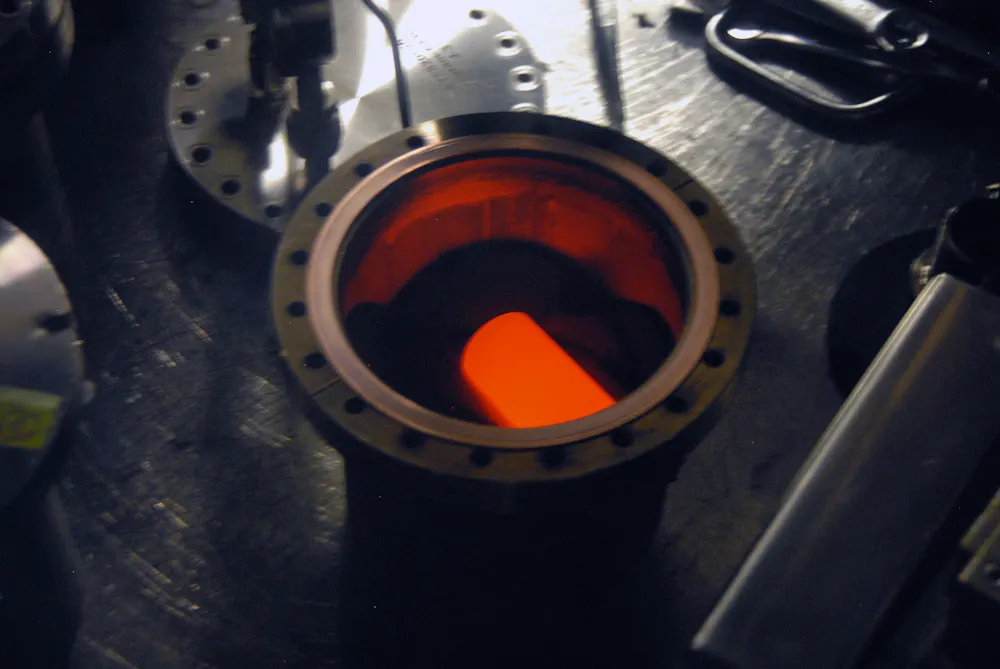
Idaho National Laboratory, CC BY
Warmth as energy
Radioisotope thermoelectric turbines can flip warmth into electrical energy utilizing a precept referred to as the Seebeck impact, found by German scientist Thomas Seebeck in 1821. As an additional benefit, the warmth from some types of RTGs may also help maintain electronics and the opposite elements of a deep-space mission heat and dealing properly.
In its primary type, the Seebeck impact describes how two wires of various conducting supplies joined in a loop produce a present in that loop when uncovered to a temperature distinction.
Units that use this precept are referred to as thermoelectric couples, or thermocouples. These thermocouples enable RTGs to provide electrical energy from the distinction in temperature created by the warmth of plutonium-238 decay and the frigid chilly of area.
Radioisotope thermoelectric generator design
In a primary radioisotope thermoelectric generator, you will have a container of plutonium-238, saved within the type of plutonium-dioxide, typically in a strong ceramic state that gives further security within the occasion of an accident. The plutonium materials is surrounded by a protecting layer of foil insulation to which a big array of thermocouples is hooked up. The entire meeting is inside a protecting aluminum casing.
The inside of the RTG and one facet of the thermocouples is saved scorching – near 1,000 levels Fahrenheit (538 levels Celsius) – whereas the surface of the RTG and the opposite facet of the thermocouples are uncovered to area. This outdoors, space-facing layer could be as chilly as a few hundred degrees Fahrenheit below zero.
This sturdy temperature distinction permits an RTG to show the warmth from radioactive decay into electrical energy. That electrical energy powers all types of spacecraft, from communications techniques to science devices to rovers on Mars, including five current NASA missions.
However don’t get too enthusiastic about shopping for an RTG for your home. With the present know-how, they will produce solely a few hundred watts of power. Which may be sufficient to energy a regular laptop computer, however not enough to play video games with a strong GPU.
For deep-space missions, nonetheless, these couple hundred watts are greater than sufficient.
The true advantage of RTGs is their skill to supply predictable, constant energy. The radioactive decay of plutonium is fixed – each second of day-after-day for many years. Over the course of about 90 years, only half the plutonium in an RTG may have decayed away. An RTG requires no transferring elements to generate electrical energy, which makes them a lot much less prone to break down or cease working.
Moreover, they’ve an excellent safety record, and so they’re designed to outlive their regular use and in addition be secure within the occasion of an accident.
RTGs in motion
RTGs have been key to the success of a lot of NASA’s photo voltaic system and deep-space missions. The Mars Curiosity and Perseverance rovers and the New Horizons spacecraft that visited Pluto in 2015 have all used RTGs. New Horizons is touring out of the photo voltaic system, the place its RTGs will present energy the place photo voltaic panels couldn’t.
Nevertheless, no missions seize the ability of RTGs fairly just like the Voyager missions. NASA launched the dual spacecraft Voyager 1 and Voyager 2 in 1977 to take a tour of the outer solar system after which journey past it.
Every craft was equipped with three RTGs, offering a complete of 470 watts of energy at launch. It has been virtually 50 years for the reason that launch of the Voyager probes, and each are nonetheless lively science missions, collecting and sending data back to Earth.
Voyager 1 and Voyager 2 are about 15.5 billion miles and 13 billion miles (almost 25 billion kilometers and 21 billion kilometers) from the Earth, respectively, making them the most distant human-made objects ever. Even at these excessive distances, their RTGs are nonetheless offering them constant energy.
These spacecraft are a testomony to the ingenuity of the engineers who first designed RTGs within the early Sixties.
Benjamin Roulston, Assistant Professor of Physics, Clarkson University. This text is republished from The Conversation underneath a Artistic Commons license. Learn the original article.

Trending Merchandise


Acer Nitro 31.5″ FHD 1920 x 1080 1500R ...



ASUS 31.5” 4K HDR Eye Care Monitor (VP327Q)...

HP 330 Wireless Keyboard and Mouse Combo R...